
Prefer to get prepared in person? Join BMCG this July for our Issues & Crisis Leadership Retreat!
A Strategic Approach to Crisis Preparedness
Your institution likely has key components in place, or your leadership team may have already grappled with—and survived!—some challenging issues. However, we would caution against being overly optimistic. It is not uncommon to overestimate a leadership team’s resilience and capability. A single slow, uncoordinated, poorly conceived, or insensitive response is all it takes to shatter stakeholder trust in the ability of your college or university, and by default your leadership team, to manage not just the crisis but the institution itself.
How does your institution score?
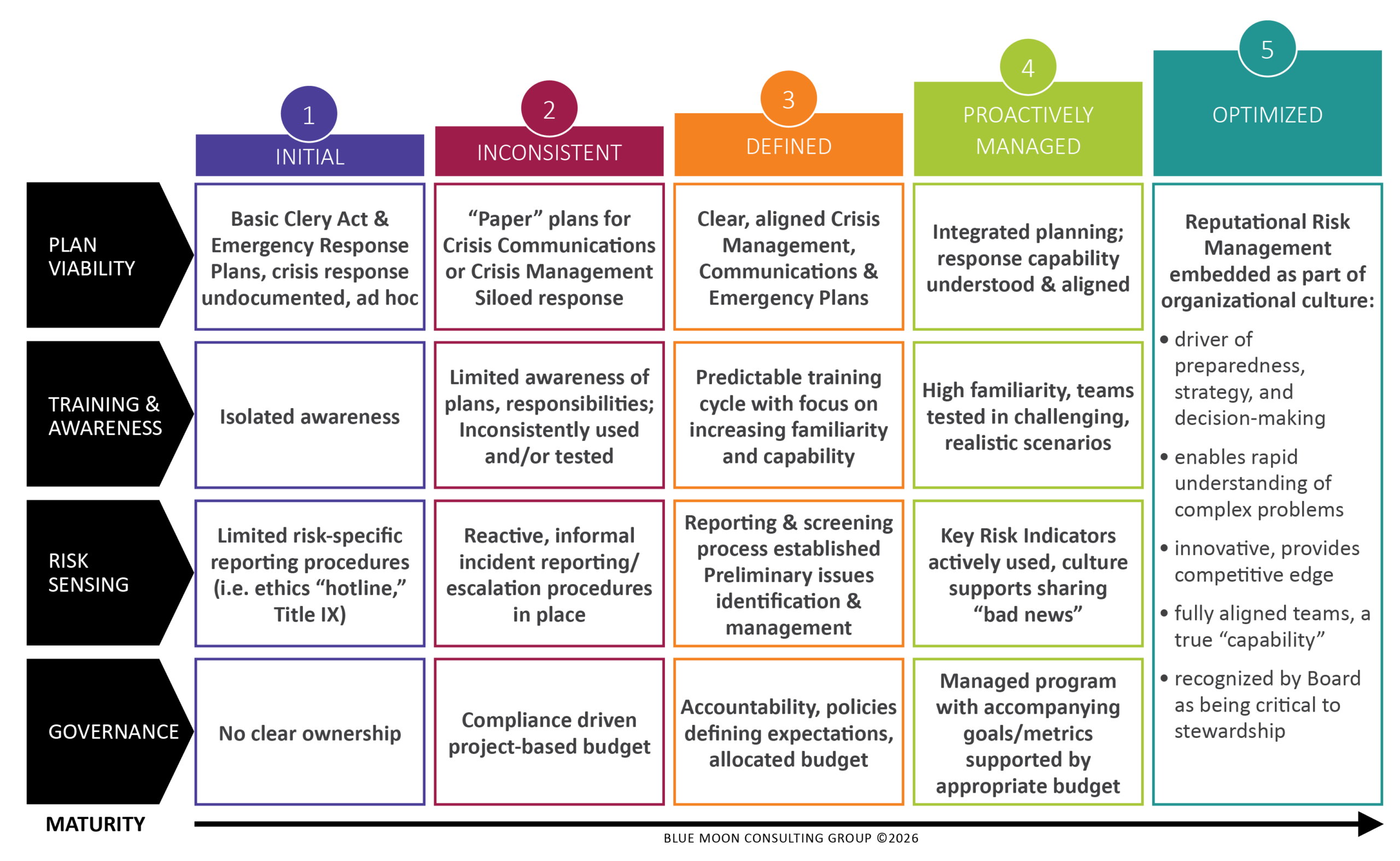
BMCG's Maturity Model
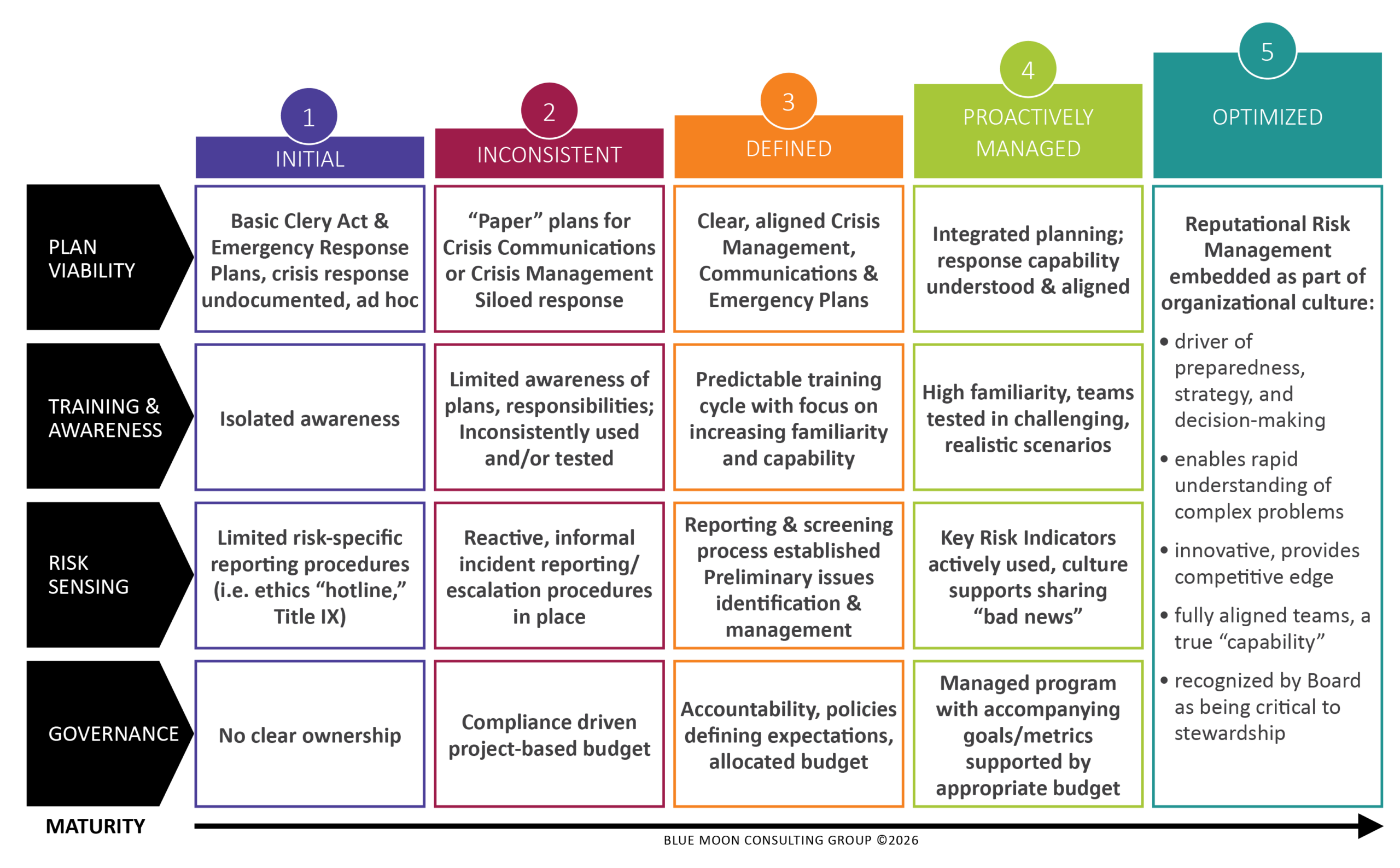
Critical Components
We’ve leveraged our team’s decades of experience in issues and crisis management to build a maturity model to help you evaluate your team and guide where your institution should focus its resources. While the work can be difficult, the results can set your college or university apart.
PLAN VIABILITY
Colleges and universities frequently rely on instinct and experience rather than—if they even exist!— documented plans. But in a crisis, the easy things are hard, and the hard things, impossible. Customized plans—tailored to your institution and team—based on best practices provide the necessary support to navigate challenging situations effectively.
TRAINING & AWARENESS
Regular training and exercises build strategic and operational preparedness across the institution. They increase team cohesion, improve individual understanding, validate written procedures, and ensure your school is genuinely crisis-ready.
RISK SENSING
Early detection tools allow an institution to identify emerging issues before they escalate into full-blown crises. This proactive approach buys your school critical time to map a different strategy, minimizing the reputational damage of slow-moving, corrosive risks.
GOVERNANCE
Effectively managing reputational risk must be a cross-functional, institutional priority driven by clear goals, supporting metrics, defined accountability, and dedicated resources. Unfortunately, wishing it doesn’t make it so.
5 QUESTIONS TO ASK YOUR TEAM
- Beyond emergency response, what plans are in place and how useful are they?
- When was the last time we participated in an exercise that was not about a physical event but reputational risk e.g. academic freedom, racial justice, protests, or an admissions, sports, financial, or accreditation scandal?
- Do we have a culture in which “bad news” is proactively shared and escalated?
- Do we have a defined process to identify, prioritize and proactively manage the top 5 issues facing our institution in the year ahead?
- Who does/should “own” managing reputational risk?
5 QUESTIONS TO ASK YOUR TEAM
- Beyond emergency response, what plans are in place and how useful are they?
- When was the last time we participated in an exercise that was not about a physical event but reputational risk e.g. sexual assault, racism, or faculty misconduct?
- Do we have a culture in which “bad news” is proactively shared and escalated?
- Do we have a defined process to identify, prioritize and proactively manage the top 5 issues facing our institution in the year ahead?
- Who does/should “own” managing reputational risk?
Critical Components
We’ve leveraged our team’s decades of experience in issues and crisis management to build a maturity model to help you evaluate your team and guide where your institution should focus its resources. While the work can be difficult, the results can set your college or university apart.
PLAN VIABILITY
Colleges and universities frequently rely on instinct and experience rather than—if they even exist!— documented plans. But in a crisis, the easy things are hard, and the hard things, impossible. Customized plans—tailored to your institution and team—based on best practices provide the necessary support to navigate challenging situations effectively.
TRAINING & AWARENESS
Regular training and exercises build strategic and operational preparedness across the institution. They increase team cohesion, improve individual understanding, validate written procedures, and ensure your school is genuinely crisis-ready.
RISK SENSING
Early detection tools allow an institution to identify emerging issues before they escalate into full-blown crises. This proactive approach buys your school critical time to map a different strategy, minimizing the reputational damage of slow-moving, corrosive risks.
GOVERNANCE REALIZATION
Effectively managing reputational risk must be a cross-functional, institutional priority driven by clear goals, supporting metrics, defined accountability, and dedicated resources. Unfortunately, wishing it doesn’t make it so.
5 Questionsto ask your team
- Beyond emergency response, what plans are in place and how useful are they?
- When was the last time we participated in an exercise that was not about a physical event but reputational risk e.g. sexual assault, racism, or faculty misconduct?
- Do we have a culture in which “bad news” is proactively shared and escalated?
- Do we have a defined process to identify, prioritize and proactively manage the top 5 issues facing our institution in the year ahead?
- Who does/should “own” managing reputational risk?
Understanding Reputational Risk
Brand is created. Brand is the story you tell about yourself—or as we like to say, “it’s the clothes you wear and the car you drive.” It may draw from your history, or it may be more aspirational — signaling to your community a strategic direction. Traditionally, brand is oriented towards a very limited number of stakeholders. Brand, in general, is well funded and well managed by your marketing and communications team.
In contrast, reputation is the complete picture of your institution built up over decades, if not centuries—to continue the metaphor, “it’s your heart and soul.” Reputation is based on the actions and behaviors of every person associated with your organization. It is the collective beliefs that your multiple stakeholders have about your products/services, values/culture, and leadership capability.
Reputational risk occurs when there is a significant gap or disconnect between stakeholder expectations and the decision-making of your organization causing potential long-term and sometimes unrecoverable damage. Reputational risk is highest during a crisis event but slow-evolving, unaddressed issues or poorly executed change management can be as corrosive over time as any crisis.
In our experience, most organizations have developed some aspects of what is required but rarely do they have a fully integrated program. For example, most institutions have insurance, compliance, and emergency response programs in place. Some may have business continuity or even enterprise risk programs. But few have a fully aligned, understood, and practiced capability with supporting goals, metrics, and budget that provides an early warning system enabling them to rapidly identify, understand, mitigate, and manage burgeoning issues or significant change.
As a result, we find that crisis management as a discipline is generally poorly defined or understood at most institutions. It can be confused with or assumed to be the same as emergency response, or business continuity, and/or just about communications. Likewise, the role of Issues Management is often viewed as post-decision “spin control,” rather than an issue identification and decision-making process that is critical to the organization’s strategy. And important change management efforts? They tend to be siloed undertakings that often fall short in identifying potential risk and, perhaps more importantly, fail to engage the key stakeholder groups integral to successful outcomes.
At Blue Moon Consulting Group our goal, in fact our singular purpose, is to help you build an organizational culture in which reputation is viewed as a key asset and fundamental strategic input into decision-making.
Understanding Reputational Risk
Brand is created. Brand is the story you tell about yourself—or as we like to say, “it’s the clothes you wear and the car you drive.” It may draw from your history, or it may be more aspirational — signaling to your community a strategic direction. Traditionally, brand is oriented towards a very limited number of stakeholders. Brand, in general, is well funded and well managed by your marketing and communications team.
In contrast, reputation is the complete picture of your institution built up over decades, if not centuries—to continue the metaphor, “it’s your heart and soul.” Reputation is based on the actions and behaviors of every person associated with your organization. It is the collective beliefs that your multiple stakeholders have about your products/services, values/culture, and leadership capability.
Reputational risk occurs when there is a significant gap or disconnect between stakeholder expectations and the decision-making of your organization causing potential long-term and sometimes unrecoverable damage. Reputational risk is highest during a crisis event but slow-evolving, unaddressed issues or poorly executed change management can be as corrosive over time as any crisis.
In our experience, most organizations have developed some aspects of what is required but rarely do they have a fully integrated program. For example, most institutions have insurance, compliance, and emergency response programs in place. Some may have business continuity or even enterprise risk programs. But few have a fully aligned, understood, and practiced capability with supporting goals, metrics, and budget that provides an early warning system enabling them to rapidly identify, understand, mitigate, and manage burgeoning issues or significant change.
As a result, we find that crisis management as a discipline is generally poorly defined or understood at most institutions. It can be confused with or assumed to be the same as emergency response, or business continuity, and/or just about communications. Likewise, the role of Issues Management is often viewed as post-decision “spin control,” rather than an issue identification and decision-making process that is critical to the organization’s strategy. And important change management efforts? They tend to be siloed undertakings that often fall short in identifying potential risk and, perhaps more importantly, fail to engage the key stakeholder groups integral to successful outcomes.
Evaluating your institution’s resilience using a maturity model is an excellent first step, but moving your leadership team to the next level requires focused time away from daily campus distractions.
Issues and Crisis Leadership Retreat
Breckenridge, Colorado
July 22-24
Join us for scenario-driven, hands-on learning.
Leave with new ideas and proactive actionable strategies.